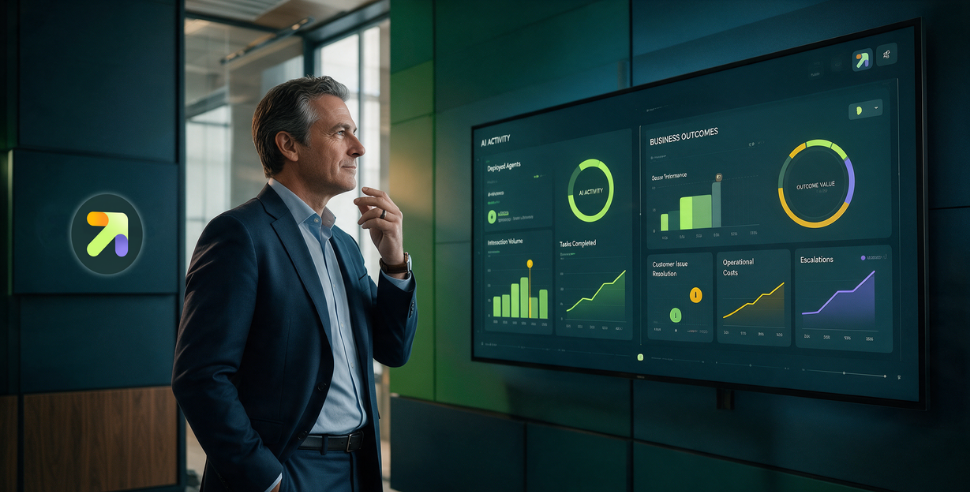
There is no shortage of discussion about the potential value of AI, organisations are investing in models, copilots, agents, and AI platforms. Employees are using AI across almost every function of the business, and increasingly, AI agents are moving beyond generating information to making decisions and taking action.
But there is a question that is becoming harder to answer:
What value is all of this AI actually creating?
It is relatively easy to measure how many people are using AI, how many agents have been deployed, or how much AI activity is taking place, It is much harder to connect that activity to business outcomes and that distinction matters, because AI adoption is not the same as AI value.
The gap between AI activity and business value
Traditional technology investments have generally been easier to associate with a business case, a CRM implementation might be measured against sales productivity, conversion or customer retention, a contact centre transformation might be measured through service levels, customer satisfaction or cost per contact and an ecommerce platform might be measured through conversion, revenue and fulfilment performance.
With AI, the picture is becoming more complicated.
An organisation can have hundreds of AI tools and agents operating across the business, but still struggle to answer:
- What is each AI system actually doing?
- What business process is it supporting?
- What decisions is it making?
- What data is it accessing?
- What does each AI interaction cost?
- What outcome is it expected to produce?
- Is the outcome actually being achieved?
- Who is accountable when it doesn't?
This is where we believe AI governance needs to evolve, it cannot simply be about approving AI tools or creating policies, it needs to connect AI activity to AI outcomes.
From monitoring AI to operating AI
This is one of the ideas behind TraphicLights.
We built TraphicLights around the observation that organisations need more than an inventory of AI systems, they need to understand how those systems operate within the business. An AI agent can have an owner, access data, make decisions, interact with other systems and ultimately create an outcome for a customer or the organisation.
That makes the agent part of the operating model.
TraphicLights provides a way to see those relationships and establish governance around them.
The objective isn't simply to ask:
"Are we allowed to use this AI?"
It is also to ask:
"Is this AI doing what we intended, within the boundaries we defined, and producing the outcome we expected?"
Connecting AI to outcomes
Consider a customer service agent, the traditional measurement might focus on the cost of the AI model or the number of interactions it handles, but the business doesn't ultimately care about the number of tokens consumed. It cares about outcomes. Was the customer's issue resolved? Was the correct process followed? Was the customer retained? Was the interaction escalated when it should have been? Was the cost of serving that customer reduced? Did the agent operate within its authority?
These are operational questions as much as technology questions. TraphicLights is designed to provide visibility across these dimensions, allowing organisations to connect an AI agent with its owner, process, data, decisions, actions, controls and outcomes, that creates a different way of thinking about AI ROI.
ROI isn't just the cost of the model
One of the risks in measuring AI value is focusing too narrowly on technology costs. An organisation might calculate the cost of an AI model, compare it with the cost of a human task and declare a saving, but that doesn't necessarily represent the true business value. The broader equation can include;
- Revenue generated
- Costs avoided
- Productivity created
- Customer outcomes
- Risk reduced
- Process performance
- Capital or operational efficiency
- Quality of decisions
- And most importantly; The cost of achieving the outcome
An inexpensive AI system that produces poor outcomes isn't necessarily creating value., likewise, a more expensive AI system that materially improves a high value business process may create significant value.
The measurement needs to move from AI activity → AI output → business outcome.
From tokens to outcomes
This is particularly important as organisations move toward agentic AI. A traditional AI interaction might generate an answer, an agent can potentially take an action. That action could update a customer record, approve a transaction, initiate a refund, change an order, communicate with a customer or trigger another AI agent. The value, and the risk therefore moves downstream.
The question becomes less about:
"What did the model generate?"
and more about:
"What happened because the AI acted?"
This is where governance and value measurement start to converge. The same visibility that helps an organisation understand risk can also help it understand performance.
Making AI measurable
We see an emerging AI operating model where every important AI system should have a clear relationship between:
Owner → Process → Data → Decision → Action → Outcome
That relationship creates the foundation for measuring AI performance. It also creates accountability. If an agent is expected to achieve a particular business outcome, the organisation should be able to understand whether it is achieving it, what happened along the way and where intervention is required. This doesn't mean every AI interaction needs a complicated ROI calculation. It means organisations should start with the business outcome they are trying to create and work backwards.
The next stage of AI maturity
The first stage of enterprise AI was largely about experimentation. Then came adoption. Now organisations are moving toward AI execution, where AI systems and agents increasingly become part of everyday operations.
That changes the question, it is no longer simply:
"Where can we use AI?"
It becomes:
"Where is AI creating measurable value, and how do we know?"
That requires visibility, accountability and continuous measurement. At TraphicLights, we believe this is where AI governance and AI operations start to come together. The goal isn't to slow AI down, it is to give organisations enough visibility and control to use it with confidence, while making the value it creates increasingly measurable.
Because ultimately, the success of AI shouldn't be measured by how much AI an organisation has. It should be measured by what the organisation achieves with it.