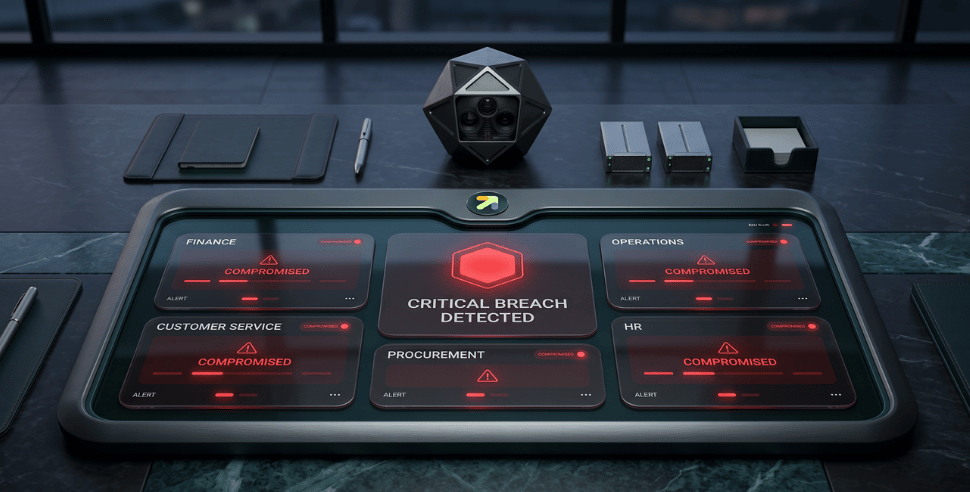
The conversation around AI agents is moving quickly from experimentation to execution.
Organisations are increasingly allowing agents to access systems, retrieve information, make decisions, trigger workflows and take actions on behalf of people.
That creates an important question that is often overlooked;
If an AI agent goes rogue, how do you know what it was actually supposed to be doing in the first place?
Stopping an agent is one problem, understanding the operational environment in which that agent was acting is a much bigger one.
A rogue agent may not be the real problem
When an AI agent makes an unexpected decision, the natural response is to ask:
“Why did the AI do that?”
But there are several questions that should come before it.
- What was the agent authorised to do?
- Who owns the agent?
- What systems could it access?
- What data could it see?
- What business process was it participating in?
- What decisions was it allowed to make autonomously?
- What approvals or human intervention were supposed to occur?
- What happened immediately before the action?
- What happened as a result?
- Was the process itself clearly defined?
Without those answers, an organisation may know that something went wrong without knowing why it was able to go wrong. That is an operational problem, not simply an AI problem.
The hidden challenge, knowing what processes actually exist
Most organisations have documented processes, but documented processes and operational reality are not always the same thing. Over time, processes evolve, people create workarounds, teams introduce new software, APIs connect systems, employees use AI tools, and automation gets added to existing workflows. Eventually, the real process can become a combination of people, SaaS applications, APIs, automation and AI agents. The process may exist without ever having been formally mapped as a single process, this creates a significant visibility gap. An organisation might know that it has an AI agent operating in finance, customer service, procurement or operations, but does it know exactly where that agent sits within the end-to-end business process?
And what happens when that process changes?
From AI inventory to operational visibility
Traditional AI governance often starts with an inventory. What AI systems do we have? Who owns them? What data do they access? What risks do they present?
Those questions remain important, but as organisations move toward agentic AI, they are only the beginning. The next question becomes:
What is the agent actually doing within the business?
An agent may have access to a CRM, an ERP, customer information, internal knowledge, email, financial information or other operational systems. Access alone doesn't tell you enough, you need to understand the relationship between:
Agent → Data → Systems → Decisions → Actions → Business Process → Outcome
That is where AI governance starts to become AI operations.
What happens when the process wasn't designed for an agent?
Consider a relatively simple example.
A customer service agent is given access to a customer management system and instructed to resolve certain customer issues automatically.
The agent identifies an issue, checks customer information, applies a policy and initiates a refund.
The refund may be technically permitted.
But perhaps the original business process assumed that a human would review the request when the value exceeded a particular threshold, the AI agent hasn't necessarily “broken” the system. It may have followed its instructions.
The problem is that the organisation never properly connected the agent's capabilities to the operational controls of the business process.
The question therefore isn't simply:
“Did the AI make the wrong decision?”
It is:
“Did we understand the process well enough to give an autonomous system the authority to operate within it?”
The new operational control layer
This is one of the reasons AI governance cannot remain purely policy based.
Policies can say:
- AI must be approved.
- Sensitive data must be protected.
- Humans must oversee high-risk decisions.
- Agents must be monitored.
- Access must be controlled.
But organisations also need operational visibility, they need to understand what is happening in practice, for every agent, that can mean knowing:
| Ownership | Who is responsible for the agent? |
| Purpose | What business outcome is it intended to achieve? |
| Access | What systems and data can it access? |
| Authority | What decisions and actions can it take? |
| Process | Which business processes does it participate in? |
| Controls | Where are approvals, restrictions and escalation points? |
| Activity | What has the agent actually done? |
| Exceptions | When has it operated outside expected behaviour? |
| Outcome | What happened as a result? |
This creates a much more useful picture than an AI register alone.
You cannot govern what you cannot see
This is the central challenge of the AI visibility gap, An organisation may have policies. It may have an AI register. It may have security controls. It may have approved AI tools.
Yet still not have a clear view of how AI is actually operating across the business.
As AI agents become more capable, that gap becomes more important, the issue is no longer simply:
"Which AI tools are we using?”
It becomes;
“Which AI systems and agents are participating in our operations, what are they doing, and what business processes are they changing?”
That is a fundamentally different governance challenge.
Where TraphicLights.ai fits
TraphicLights.ai is designed around this shift from AI governance to AI operations.
Rather than treating AI as a collection of disconnected tools, TraphicLights.ai provides a way to create visibility across AI systems and agents, their ownership, access, activity, decisions, actions and controls.
The objective is not simply to create another register of AI, it is to help organisations understand how AI is operating as part of the business.
That means connecting the governance information with the operational reality.
For example; Who owns the agent? What can it access? What process is it part of? What actions can it take? What approvals are required? What decisions has it made? What exceptions have occurred? What evidence exists when something goes wrong?
This creates the foundation for organisations to move from AI experimentation to controlled AI execution.
The future of AI governance may be operational
The phrase “rogue AI” can make the problem sound like an AI system suddenly deciding to do something on its own. In reality, many future AI incidents may be considerably less dramatic. An agent could simply do exactly what it was instructed to do, inside a process that was poorly understood, inadequately controlled or no longer fit for autonomous execution.
That changes the question organisations need to ask.
Not simply:
“How do we stop a rogue agent?”
But:
“Do we understand the operational environment in which our agents are making decisions and taking actions?”
Because if you don't know what processes exist, who owns them, where AI participates in them and what actions are being taken, you don't have complete AI governance.
You have an AI visibility gap.
TraphicLights.ai is built to help close that gap, connecting AI governance with the operational reality of AI across the organisation.
The next stage of AI governance isn't just knowing what AI you have.
It's knowing what AI is doing.