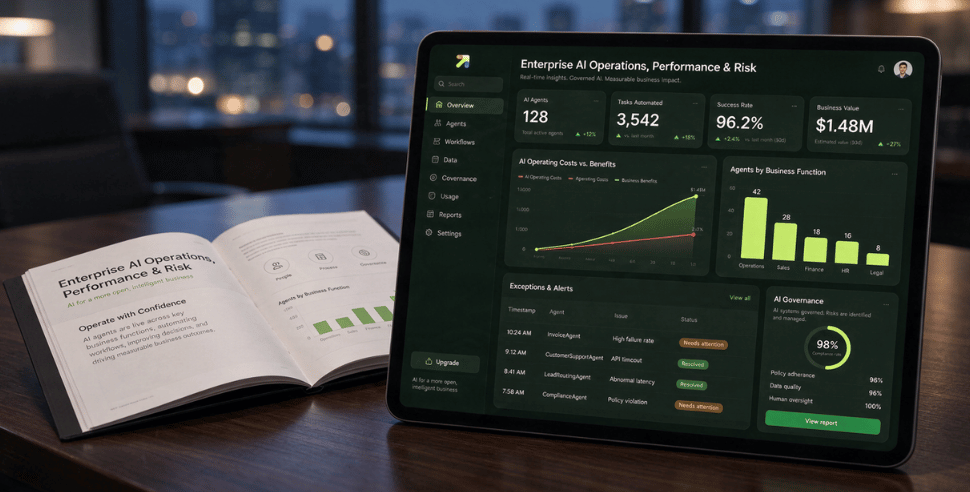
As AI becomes embedded in everyday business operations, board reporting will need to evolve.
Cybersecurity, data protection, AI governance and operational performance will all become part of a much bigger conversation about how enterprises manage their AI workforce.
We have been thinking about what a typical enterprise board report might look like in 2028.
Not that far away, yet potentially a very different operating environment from the one most organisations manage today, for years, boards have received established reporting on financial performance, people, operations, technology, cybersecurity, risk and compliance. AI has generally appeared as a separate agenda item. An update on strategy, investment, implementation progress or emerging risks, but what happens when AI is no longer something the organisation is implementing and becomes part of how the organisation actually operates?
When AI agents are managing customer interactions, processing transactions, supporting financial decisions, coordinating supply chains, developing software and executing business workflows?
I suspect the questions being asked in boardrooms will change considerably.
The question won't simply be how much AI the organisation has deployed. It will be whether the board has sufficient visibility to understand how that AI is performing, what decisions it is making, what it costs and whether the organisation remains in control.
Imagine opening a board paper in 2028
Alongside the traditional financial, operational and risk reports, there is now a consolidated section titled:
Enterprise AI Operations, Performance & Risk
It doesn't simply list AI initiatives or provide an update on the organisation's AI strategy, it reports on AI as an established part of the enterprise operating model.
The board can see how many AI agents are operating across the organisation, what business activities they perform and who is accountable for them, it can see their contribution to productivity, customer outcomes and financial performance, and it can also see where agents have exceeded their delegated authority, where human intervention has been required, and whether the organisation's security and risk controls are operating effectively.
Consider a hypothetical quarterly report showing:
| Enterprise AI reporting | Illustrative measures |
|---|---|
| AI workforce | 1,240 active agents across 18 business functions |
| Operational performance | 94% workflow adherence |
| Financial contribution | $8.4 million annualised benefits |
| AI operating costs | $2.1 million annualised |
| Human oversight | 3.8% of decisions escalated for review |
| Operational risk | 14 material exceptions, 2 unresolved |
| Cybersecurity | AI-related threats, access violations and security incidents |
| Data governance | Data access, privacy exceptions and policy compliance |
| Accountability | Every production agent assigned an accountable business owner |
These figures are illustrative, not actual enterprise or TraphicLights customer results.
What makes this different from today's reporting is not necessarily the individual measures., it's that the board is receiving a consolidated view of AI as a business operation, rather than a collection of technology projects.
Cybersecurity is essential, but it is only one part of the picture.
As AI becomes more autonomous, enterprise cybersecurity will become even more important, AI agents will need access to applications, databases, customer information and business systems, and some will be authorised to execute transactions or make decisions that have real financial and operational consequences.
Existing cybersecurity capabilities will remain critical, but organisations will also need controls specifically designed for AI and autonomous agents. Identity and access management will need to account for non human identities and delegated permissions.
Data security systems will need to monitor what information agents access, process and share. Security monitoring will need to detect malicious instructions, compromised agents, abnormal activity and attempts to exploit AI systems. Cloud and infrastructure security will continue protecting the environments in which models and agents operate. And enterprise risk and compliance teams will need evidence that AI is operating within approved legal, regulatory and business requirements.
These capabilities will need to work together.
However, there is an important distinction between an AI agent operating securely and an AI agent operating correctly.
An AI agent could have legitimate access to a customer account, operate within its technical permissions and trigger no cybersecurity alerts, yet that same agent could approve an inappropriate refund, incorrectly interpret a business rule, exceed its delegated decision authority or fail to escalate a customer complaint.
From a cybersecurity perspective, the activity may be authorised.
From a business operations perspective, it may represent a significant failure.
That is why cybersecurity alone cannot provide the complete management picture.
The enterprise will need several connected layers of control
By 2028, we expect mature enterprises will increasingly bring together several complementary capabilities.
Cybersecurity and threat protection will safeguard systems, applications, networks and AI infrastructure against malicious activity and compromise.
Identity and access management will determine which systems, data and actions each AI agent is permitted to access or execute, including controls over non-human identities.
Data governance and privacy will manage information access, classification, retention, data residency and regulatory obligations.
AI security and model assurance will address risks specific to AI, including prompt injection, model vulnerabilities, unsafe outputs, testing and ongoing assurance.
Enterprise risk and compliance will establish the organisation's risk appetite, regulatory obligations, policies and assurance requirements.
And critically, AI operational management and governance will provide visibility into what agents are actually doing within business workflows, whether they are meeting expected performance standards, how much they cost and when human intervention is required.
These are not necessarily six separate technology platforms. Many organisations will already have overlapping capabilities across their existing systems.
The challenge will be integrating them into a coherent enterprise operating and reporting model.
Where TraphicLights.ai fits into this architecture
This is where we see the role of TraphicLights.ai, we originally started building the platform because, as we transformed our own organisation to become AI native, we needed greater visibility and control over how AI was being used and managed.
The challenge wasn't simply securing the technology., it was understanding what AI was doing across the business, whether it was performing as expected, what it was costing and who was accountable. TraphicLights is designed to provide an AI agent development, operational management and governance environment that complements the enterprise's existing technology and security architecture.
Organisations can build AI agents within TraphicLights or bring externally developed agents into the platform for operational management and oversight.
That distinction matters.
We don't believe large enterprises will operate all their AI agents through a single development framework or technology provider, they will have agents built internally, delivered by technology partners, embedded within enterprise applications and developed using different AI platforms.
But regardless of where those agents originate, the business will still need a consistent way to manage them. TraphicLights provides the operational layer for managing agent ownership, workflows, adherence, performance, costs, exceptions, human approvals and decision traceability, its Captain and Marshal oversight model is designed to connect AI activity with defined business responsibilities and human accountability.
The objective is not to replace the cybersecurity, identity, data protection or risk management systems already operating within the enterprise, it is to complement them by addressing a different question:
Beyond whether an AI agent is secure and authorised, is it actually doing the right work, in the right way, within the business rules and authority it has been given?
That operational intelligence can then contribute to the consolidated information executives and boards need.
From AI governance to AI operations
There is another important shift we expect to see, much of today's AI governance conversation focuses on frameworks, policies, risk assessments, approval processes and compliance obligations and these are necessary foundations, but a policy cannot tell the COO whether an agent failed to follow an approved workflow yesterday. A risk register alone cannot tell the CFO whether AI operating costs are increasing faster than the value being delivered. And an AI inventory doesn't necessarily tell the board whether thousands of autonomous decisions are being made within approved business thresholds.
As AI becomes mainstream, governance will need to move beyond documentation and become part of everyday operational management. We already understand this in traditional business operations, we don't manage a contact centre simply by having documented procedures. We monitor service levels, productivity, quality, adherence, escalations, customer outcomes and costs. We don't manage financial operations without controls, reconciliations, exceptions and accountability. AI agents performing those activities should be subject to equally disciplined operational management, adapted to the risks and capabilities of AI.
AI governance will increasingly become inseparable from AI operations.
The board will need a consolidated view, not another technology dashboard
One of the biggest challenges will be ensuring boards aren't overwhelmed with disconnected reporting.
The CISO may report that AI systems remain secure.
The CIO may report that infrastructure availability and model performance are meeting expectations.
The COO may report that AI agents are improving operational productivity.
The CFO may report that AI costs have increased.
And the CRO may report growing exposure from autonomous decision-making.
Each report could be accurate, but without a consolidated view, the board may still struggle to understand whether the organisation is managing AI effectively.
By 2028, we expect the most mature organisations will be bringing these perspectives together, not necessarily through one system, but through an integrated reporting framework that connects cybersecurity, data protection, AI operational management, financial performance and enterprise risk.
This is where platforms such as TraphicLights.ai can provide an important part of the underlying operational evidence. The board doesn't need to see every agent interaction or technical event, it needs to understand the material outcomes, emerging risks, financial contribution, exceptions and management actions, and it needs confidence that the underlying information can be traced back to reliable operational records.
Who will be accountable?
This may be one of the more difficult questions organisations face. If an AI agent makes an incorrect decision, who is responsible? The developer who built it? The technology team that deployed it? The business unit that uses it? The executive who approved its authority? Or the person responsible for monitoring its performance? The answer cannot simply be that the AI made the decision.
Organisations will need clearly defined ownership, delegated authority, approval thresholds, escalation arrangements and human oversight. That responsibility will need to extend across both internally developed and externally supplied agents, and boards will increasingly expect evidence that these arrangements are operating effectively, rather than simply documented in policy.
The questions boards will be asking in 2028
Today, a board might ask:
What is our AI strategy?
How many AI projects are underway?
Are we managing the risks associated with AI?
By 2028, we suspect the questions will become much more operational.
How much of our business activity is now being performed by AI agents?
Which decisions are agents authorised to make without human approval?
Are those agents performing within our operational and risk tolerances?
How do we know their identities, permissions and data access remain secure?
What financial returns are we generating, and what does our AI workforce cost to operate?
Where are we seeing exceptions, incidents or unexpected behaviour?
Who is accountable when something goes wrong?
And perhaps the most important question:
Can management demonstrate that it has effective control over the AI systems and agents now operating across the enterprise?
The next evolution of enterprise reporting
We don't believe AI will remain a standalone technology agenda item indefinitely.
As it becomes embedded across organisations, AI performance and risk reporting will increasingly become part of existing board discussions about operations, finance, security, risk and business strategy.
The CFO will want to understand financial value.
The COO will want to understand performance, capacity and adherence.
The CISO will want assurance over security, identities and information protection.
The CRO will want evidence of risk management, controls and compliance.
And the board will need confidence that all these capabilities are working together.
That is the future we are building towards with TraphicLights: an operational management environment that allows organisations to build, connect, supervise and manage AI agents, while contributing the information required for enterprise-wide oversight.
We have spent the last few years discussing how AI will transform the way businesses work.
The next challenge is transforming how businesses manage, control and report on the work AI performs.
By 2028, we suspect the most revealing board papers won't be the ones describing an organisation's ambitions for AI.
They will be the ones demonstrating that the organisation knows what its AI is doing, understands the value it creates and can show that it remains firmly in control.