AI governance in 2026, why businesses need an AI operating model, not Just AI tools
The real challenge is knowing what your AI is doing.
Businesses around the world are investing heavily in artificial intelligence. Teams are using ChatGPT to draft proposals, developers are relying on AI coding assistants, marketing departments are generating content in seconds, and customer service teams are deploying AI agents to improve response times.
AI adoption isn't coming.
It's already here.
The problem is that, for many organisations, it has happened organicall, with little visibility, limited governance, and no clear ownership.
That's where the real risk begins.
You're already using AI, the question is: who's managing it?
Most organisations don't have an AI problem.
They have an operations problem.
Different departments adopt different AI tools. Employees create AI agents to automate tasks. New AI capabilities are introduced through software updates without IT or compliance teams being aware.
Before long, businesses find themselves asking questions they can't easily answer;
-
Which AI models are being used across the organisation?
-
Who approved them?
-
What data is being shared?
-
Who owns each AI agent?
-
Can we monitor AI activity?
-
Are we meeting regulatory requirements?
-
What is our AI costing us
If you don't know the answers, you're not alone
Many businesses are already operating in an environment where AI is fragmented, ungoverned, and largely invisible.
As AI regulation continues to evolve, that lack of visibility becomes a business risk.
Regulation is raising the bar
Governments and regulators aren't trying to stop organisations from using AI.
They're increasingly expecting businesses to demonstrate that AI is being used responsibly, securely, and with appropriate oversight.
That means organisations will need to show they can;
-
Understand where AI is being used.
-
Control access to AI systems.
-
Protect sensitive information.
-
Monitor AI activity.
-
Maintain audit trails.
-
Assign ownership and accountability.
- Demonstrate governance when required.
For many businesses, these aren't capabilities they currently have.
AI governance starts with visibility
You can't govern what you can't see.
Before organisations can think about compliance, they first need a clear picture of their AI landscape.
That includes understanding:
-
Which AI models are connected to the business.
-
Which AI agents have been created.
-
Who owns them.
-
What business processes they support.
-
What data they access.
-
How frequently they're used.
-
What they're costing the organisation.
Without this visibility, governance becomes reactive rather than proactive.
The next challenge isn't more AI, it's better AI operations.
The next phase of AI adoption won't be won by organisations using the most AI tools
It will be won by those managing AI as a strategic business capability.
That means moving beyond isolated tools and creating an operating model that gives leaders confidence that AI is secure, governed, and delivering measurable value.
Businesses should be asking:
-
Can we manage AI across multiple platforms?
-
Can we monitor AI activity in real time?
-
Do we know who is responsible for every AI agent?
-
Can we control permissions and access?
-
Are governance policies being followed?
-
Can we measure return on investment?
If the answer is no, the organisation isn't ready for the next wave of AI.
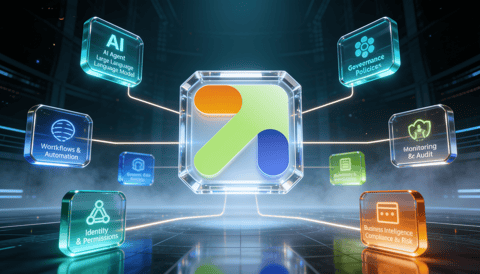
Building an AI operating model
Successful organisations are beginning to treat AI like any other critical business function.
Instead of allowing individual teams to adopt AI independently, they're creating a central operating model that provides consistency across the business.
An effective AI operating model should enable organisations to;
Connect the right AI models
Not every AI model is suitable for every business.
Organisations need the flexibility to connect the models that best meet their security, compliance, performance, and operational requirements.
Create and manage AI agents
AI agents are rapidly becoming digital teammates.
Without central management, however, they can quickly become difficult to monitor, duplicate work, or introduce unnecessary risk.
Managing AI agents from a single platform provides consistency, visibility, and control.
Monitor AI activity
Business leaders should understand how AI is being used across the organisation—not months later through reports, but in real time.
Activity monitoring provides the insight needed to identify opportunities, improve adoption, and manage emerging risks.
Assign ownership and accountability
Every AI system should have a clearly identified owner.
Whether it's an AI assistant supporting HR or an agent automating customer service, accountability is essential for governance and operational resilience.
Control permissions and access
As AI becomes integrated into more business processes, controlling who can access models, agents, and data becomes increasingly important.
Role-based permissions reduce security risks while enabling employees to work effectively.
Maintain audit trails
As regulatory expectations continue to grow, organisations will increasingly need evidence of how AI is being used.
Comprehensive audit trails provide transparency for internal governance, customers, and regulators alike.
Monitor AI costs
AI investment can quickly expand beyond initial expectations.
Understanding usage, consumption, and associated costs helps organisations optimise spend while maximising business value.
Establish governance policies
Policies should not exist only in documents.
They should be embedded into how AI is deployed, managed, and monitored across the organisation.
Governance becomes far more effective when it's operational rather than theoretical.
From AI adoption to AI transformation
The conversation is shifting.
It's no longer about whether organisations should use AI.
It's about whether they can manage AI effectively at scale.
The businesses that succeed won't necessarily be those with the largest AI budgets or the newest models.
They'll be the organisations that build an operating model that gives them visibility, accountability, governance, and confidence.
The future of AI is managed AI
That makes governance, accountability, and operational control business priorities, not just IT responsibilities.
The organisations that thrive over the next decade will be those that move beyond disconnected AI tools and build a unified approach to managing AI across the enterprise.
Because successful AI isn't defined by how many models you use.
It's defined by how well you manage them.
That's where transformation begins.
An AI operating model is a structured approach to managing AI across an organisation, covering how AI tools and agents are deployed, who owns them, how access is controlled, how activity is monitored, and how governance policies are enforced. It moves AI from a collection of disconnected tools into a managed business capability
AI adoption has outpaced oversight in most organisations. Teams are using AI tools, deploying agents, and sharing data without central visibility or accountability. As regulatory expectations grow, businesses need to demonstrate that AI is being used responsibly, securely, and with appropriate controls in place.
Using AI means deploying tools to automate tasks. Managing AI means having visibility into every model and agent running across the business, knowing who owns them, controlling access, monitoring activity, maintaining audit trails, and measuring value. Most organisations are doing the former without the latter.
The critical questions are: which AI models are in use, who approved them, what data they are accessing, who owns each agent, whether activity can be monitored in real time, whether governance policies are being followed, and what AI is costing the organisation.
Traphiclights gives organisations one platform to connect AI models, create and manage agents, monitor activity, assign ownership, control permissions, maintain audit trails, and track costs, turning AI governance from a theoretical policy into an operational reality.