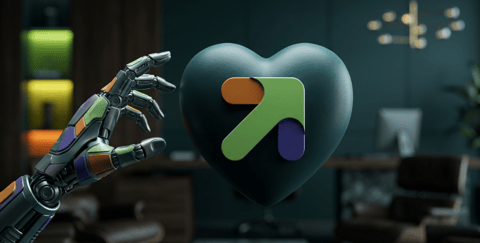
Every great relationship begins with possibility.
There is excitement, optimism., a vision of what the future could be.
Today, many organizations find themselves in exactly this phase with Artificial Intelligence.
Boardrooms are filled with ambition. Executive teams are imagining new levels of productivity. Business leaders are envisioning faster decisions, smarter operations, and entirely new business models. AI has captured the imagination of the enterprise.
Organizations have fallen in love with the promise of AI.
But as with any relationship, the excitement of possibility eventually meets the reality of commitment.
And that is where many organizations are struggling.
The Gap Between Ambition and Reality
The ambition is clear.
Organizations want AI to transform customer experiences, improve operational efficiency, empower employees, and unlock new sources of growth.
Yet despite significant investment, many executives are asking a difficult question:
"Why aren't we seeing the outcomes we expected?"
The answer is rarely a technology problem.
Most organizations already have access to powerful AI capabilities.
The challenge lies elsewhere.
AI ambition is growing faster than organizational readiness.
While executives are focused on the destination, many organizations have not yet built the operating model required to reach it.
As a result, AI initiatives often become fragmented:
-
Individual business units launch disconnected projects.
-
Teams adopt different tools and models.
-
Governance policies remain unclear.
-
Risks are discovered late.
-
Success is difficult to measure.
-
Executive visibility is limited.
The organization loves the idea of AI but struggles to build a sustainable relationship with it.
The Difference Between Infatuation and Commitment
In relationships, enthusiasm alone is not enough.
Long-term success requires trust, communication, accountability, and shared expectations.
The same is true for AI.
Organizations often begin their AI journey with experimentation and innovation. These are important first steps.
But eventually, every enterprise reaches a point where it must answer deeper questions:
-
Who owns AI outcomes?
-
How are risks assessed?
-
How are decisions governed?
-
How is value measured?
-
How do we ensure compliance?
-
How do we scale responsibly?
These are not technology questions.
They are business, operational, and governance questions.
The organizations succeeding with AI are not necessarily those using the most advanced models.
They are the organizations building the strongest foundations.
Why AI Needs an Operating System for the Enterprise
As AI becomes embedded across the organization, managing it through spreadsheets, policy documents, and disconnected governance processes becomes increasingly difficult.
Executives need a way to connect strategy, execution, governance, and measurement.
They need visibility into what AI initiatives exist, how they align to business objectives, where risks reside, and what value is being created.
Most importantly, they need a framework that allows innovation and governance to work together rather than compete against one another.
This is why a new category of enterprise capability is emerging: the AI Operating and Governance Platform.
Just as ERP systems became the operating backbone for finance and operations, organizations now require a dedicated platform to manage AI as an enterprise capability.
Turning Ambition into Execution
TRAPHFICLIGHTS was created to help organizations close the gap between AI ambition and AI execution.
Rather than focusing solely on technology, the platform provides the operational framework required to manage AI across the enterprise.
It enables leaders to move from isolated experiments to coordinated execution by bringing together:
-
AI strategy and business objectives
-
Governance and policy management
-
Risk and compliance oversight
-
AI initiative and use case management
-
Performance and value tracking
-
Executive reporting and visibility
-
Human accountability and oversight
By creating a single system of governance and execution, TRAPHFICLIGHTS helps organizations build trust in AI while accelerating adoption.
The result is not simply better control.
It is better outcomes.
Building a Relationship That Lasts
The future of AI will not be determined by technology alone.
Technology may create the opportunity, but sustainable value comes from how organizations operationalize, govern, and scale it.
The most successful organizations will be those that move beyond the initial excitement and build the structures necessary for long-term success.
Because falling in love with AI is easy.
The real challenge is building a relationship that lasts.
That requires trust.
It requires accountability.
It requires governance.
And it requires an operating model that transforms ambition into execution.
Organizations that make this transition will discover that AI is more than a technology investment.
It becomes a trusted partner in achieving their strategic goals.
And like any successful relationship, the greatest value is created not in the excitement of the beginning, but in the discipline, commitment, and trust that follow.