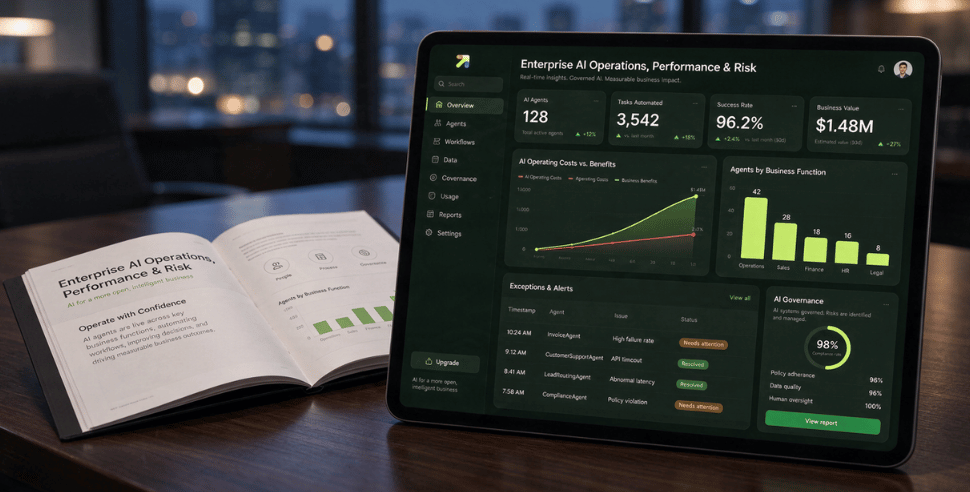
As energy, water and utility providers move from AI experimentation to operational deployment, the challenge is no longer simply what AI can do. It is how organisations maintain visibility, accountability and control over what AI is actually doing.
The next phase of AI in utilities is operational
Utilities have been using automation, analytics and predictive technologies for years, from forecasting energy demand and managing network assets to identifying infrastructure faults, scheduling maintenance and supporting customer operations, technology is already deeply embedded in how essential services are delivered.
AI is now introducing a different level of capability, rather than simply analysing information or recommending actions, AI agents are increasingly capable of coordinating workflows, interacting with enterprise systems, making decisions within defined parameters and initiating operational activities.
Consider an electricity provider using AI to identify potential network failures, prioritise maintenance, coordinate field service teams and communicate with affected customers. Individually, these capabilities can deliver significant operational improvements, but when they begin operating together, a different set of questions emerges.
Who is responsible for the decisions being made? What systems can the AI access? What actions can it take without human approval? How does the organisation know whether it is operating within its intended boundaries?
And importantly, what happens when one AI agent makes a perfectly reasonable decision that creates an unintended consequence somewhere else in the business?
This is where AI governance needs to become part of day to day operations.
Utilities cannot afford an AI visibility gap
Most utilities already have established systems for managing operational risk, cybersecurity, asset performance, regulatory compliance and service continuity. However, these systems were not necessarily designed to oversee an expanding workforce of AI agents operating across multiple business functions.
A utility might deploy AI across:
- Network and asset management: Predicting equipment failures, prioritising maintenance and identifying emerging operational risks.
- Field service operations: Coordinating technicians, scheduling repairs and managing work orders.
- Customer operations: Handling billing enquiries, service requests, complaints and outage communications.
- Energy and demand management: Supporting forecasting, consumption analysis and operational planning.
- Corporate functions: Automating procurement, finance, compliance reporting and internal workflows.
Each implementation may have a defined business case, technology owner and set of controls, the difficulty begins when these AI systems interact with one another, with existing operational platforms and with employees. An agent optimising maintenance costs might recommend delaying work that another system has identified as operationally important. A customer service agent might communicate an estimated restoration time based on incomplete or outdated network information. An automated workflow might initiate an action that is technically permitted but inconsistent with broader operational priorities. None of these examples necessarily involves a cybersecurity breach or a failed AI model.
They illustrate something different: an operational visibility gap between what AI is authorised to do and the wider consequences of what it actually does.
Governance must extend beyond the technology
Traditional IT governance focuses heavily on technology assets, system access, security, availability and change management.
These remain essential.
But AI introduces another dimension.
An organisation now needs to understand not only whether a system is secure and functioning correctly, but whether the AI operating within it is behaving as intended.
That requires answers to some very practical questions:
- Which AI agents are currently operating across the organisation?
- Who is accountable for each agent and its business outcomes?
- What information can each agent access, and what systems can it change?
- Which decisions require human approval?
- How are exceptions, unexpected actions and operational risks identified?
- What does each agent cost to operate, and what value is it delivering?
For utility providers, these are not simply technology questions, they are operational management questions that need to be understood across business functions, risk teams and executive leadership.
The missing layer between AI and enterprise operations
This is the challenge TraphicLights.ai was designed to address.
TraphicLights provides an AI operating and governance layer that helps organisations manage AI systems and agents as part of their wider business operations, rather than replacing existing cybersecurity, asset management, enterprise applications or operational control systems, it is designed to complement them.
AI agents can be developed within TraphicLights or brought into the platform from other environments, providing a common framework for operational visibility and governance.
For a utility provider, this creates several important capabilities.
1. A live view of the AI operating environment
Maintain visibility of AI systems and agents, their owners, business purposes, access permissions, risk classifications and operational status.
This becomes increasingly important as different departments introduce their own AI capabilities.
2. Defined ownership and accountability
Every AI agent should have a clearly identified business owner.
TraphicLights supports this through its Captain oversight model, helping establish responsibility, approval requirements and escalation pathways.
3. Human oversight where it matters
Not every AI action should require human intervention.
But decisions with significant customer, financial, safety or operational implications need clearly defined controls.
TraphicLights supports agent to human handoffs so employees can review decisions with the relevant context before an action proceeds.
4. Monitoring operational behaviour
An AI agent can be technically functioning while still performing outside its intended operational boundaries.
Monitoring adherence, exceptions, actions and escalation events helps organisations identify these situations before they become wider business problems.
5. Understanding the economics of AI
As AI adoption grows, utilities will need visibility into the cost of running agents, the resources they consume and the operational value they create.
Measuring AI performance needs to move beyond model usage and token consumption towards business outcomes.
A practical example: AI managing a network maintenance workflow
Imagine a utility provider introducing AI agents to support preventive maintenance across its network.
One agent analyses asset condition and identifies potential failures.
A second agent evaluates maintenance priorities against available resources.
A third coordinates field service scheduling.
A fourth prepares customer notifications where planned maintenance may affect service availability.
The potential benefits are substantial: faster identification of problems, improved resource utilisation, fewer manual handoffs and more consistent customer communication.
But who is overseeing the entire workflow?
What happens if the scheduling agent moves a maintenance activity that has already been identified as high risk?
What happens if the customer communications agent publishes information before the operational team has confirmed the maintenance window?
And how does management reconstruct what happened if an automated decision results in an operational incident?
With TraphicLights operating as the AI management layer, these agents can be registered, assigned accountable owners and monitored against defined operational requirements.
Actions that exceed agreed thresholds can be escalated for human review. Exceptions and decisions can be recorded to support investigation, reporting and continuous improvement.
Importantly, the platform does not need to replace the utility's existing maintenance, asset management or field service applications.
Its role is to provide visibility and governance over the AI activities interacting with those environments, subject to the integrations and controls implemented.
Regulation is only part of the challenge
Utilities already operate under demanding regulatory and operational obligations.
In Australia, energy providers must consider frameworks such as the Security of Critical Infrastructure Act, applicable energy market requirements and industry-specific obligations. Water utilities face their own jurisdictional requirements and critical infrastructure responsibilities.
Similar pressures exist internationally, including cybersecurity, critical infrastructure resilience and emerging AI governance expectations.
These requirements reinforce the need for clear accountability, risk management, security and operational evidence.
But compliance alone is not the objective.
The greater challenge is ensuring that organisations can confidently introduce AI into operational environments without losing the controls that make essential services reliable.
A governance policy may establish what an AI agent is permitted to do.
An operating platform needs to help management understand whether those requirements are being followed in practice.
That distinction will become increasingly important as AI moves from supporting employees to performing activities on their behalf.
From AI projects to an AI operating model
The opportunity for utilities is significant.
AI can improve infrastructure reliability, reduce administrative workloads, support more responsive customer service and help organisations make better use of operational resources.
But scaling these capabilities requires more than successful individual implementations.
It requires an operating model that connects technology, people, risk, accountability and business performance.
Utilities have spent decades developing disciplined approaches to managing physical assets, operational systems and critical infrastructure.
As AI becomes another active participant in these environments, it needs a comparable level of operational oversight.
The question for utility executives is no longer simply where AI can improve performance. It is whether the organisation has the visibility and control to manage AI as it becomes part of everyday operations.
That is the shift from AI experimentation to AI operations.
And it is where TraphicLights.ai is focused: helping organisations govern AI where work actually happens, not simply where the technology sits.